What if the future of cancer prevention begins with understanding aging?
Aging is more than the passage of time.
It is a biological process involving changes in our cells, immune system, gene regulation and tissue environment.
EMPRSX is investigating what happens before cancer becomes clinically apparent.
Advancing age is the most important overall risk factor for cancer.
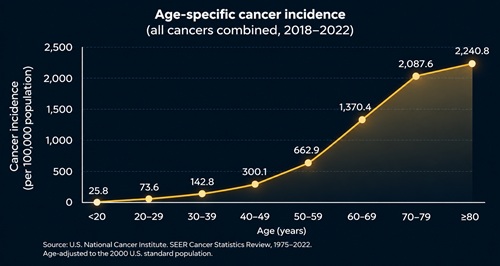
As we age, the likelihood of developing cancer increases substantially across many cancer types
01
CANCER IS AN AGE-ASSOCIATED DISEASE
Cancer incidence increases substantially with advancing age.
Aging is accompanied by cumulative changes in cells, tissues and biological systems that can influence cancer susceptibility.
02
CANCER INCIDENCE RISES STEEPLY WITH AGE
The relationship is not linear.
Cancer incidence rises steeply with advancing age, although the pattern varies across different cancer types.
03
AGING CHANGES THE BIOLOGICAL ENVIRONMENT
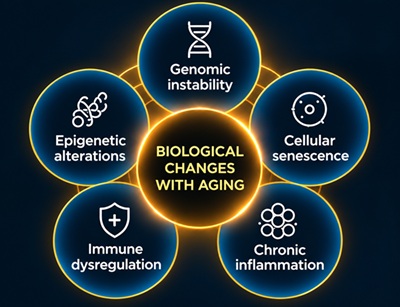
As age advances, cumulative changes in the genome, epigenome, cellular function, immune system and tissue environment can alter the biological context in which abnormal cells arise and evolve.
SO WHAT'S BEHIND THIS INCREASE?
AGING IS A BIOLOGICAL PROCESS
What happens inside the body as we age that can influence cancer risk?
Aging is a biological process accompanied by interconnected changes across cells, tissues and biological systems. Over time, these changes can alter the biological environment in which abnormal cell arise and evolve
01
AGING
With time, cell and tissue undergo cumulative changes, influenced by genetic, environmental and lifestyle factors.
02
CELLULAR CHANGES
Cells may experience senescence, reduced functional capacity and altered cellular communication.
03
MOLECULAR CHANGES
Accumulation of genomic damage, epigenetic alterations and changes in gene expression can affect cellular function.
04
IMMUNE & TISSUE CHANGES
The immune system may become dysregulated and the tissue environment can change. with increase inflammation and altered intercellular signalling.
05
CHANGING BIOLOGICAL ENVIRONMENT
These interconnected changes can create a bilogical environment that is more permissive to abnormal cell behaviour.
06
CANCER SUSCEPTIBILITY
Over time, these age-associated processes may contribute to an increased susceptibility for cancer development.
SIX INTERCONNECTED BIOLOGICAL PROCESSES
Aging is not driven by a single biological process. Multiple interconnected mechanisms influence cellular function, tissue homeostasis and the biological environment over time
01
GENOME
Genomic instability
Accumulation of DNS damage and reduced can increase mutation risk and affect cellular function.
02
EPIGENOME
Epigenetic alterations
Changes in DNA methylation, histone modification and affect gene expression during aging.
03
CELLS
Cellular senescence
Aged cells may lose function, adopt a senescent phenotype that influence the tissue environment.
04
IMMUNITY
Immune dysregulation
Aging can impact both innate and adaptive immunity reducing immune surveillance and altering inflammatory responses.
05
INFLAMMATION
Chronic inflammation
Persistent low-grade inflammation, often termed inflammation can influence and promote tumorigenesis.
06
METABOLISM
Mitochondrial & metabolic changes
Altered mitochondrial function and cellular metabolism can affect energy homeostasis and increase oxidative stress.
AGING IS NOT A PROCESS
These biological mechanisms interact with one another over time, influencing the environment in which cancer can develop.
WE KNOW AGING
CHANGES BIOLOGY
BUT THAT'S ONLY PART OF THE STORY
THE QUESTION IS
WHAT WE CAN DO WITH
THAT KNOWLEDGE
Can selected biological pathways associated with aging - including immune regulation and epigenetic changes to be modulated as part of the prevention-oriented approach to cancer research?
EMPRSX investigates selected biological pathways associated with aging, with a focus on immune regulation and epigenetic processes, as part of a prevention-oriented approach to cancer research
01
AGING BIOLOGY
Understanding the biological changes that occur with age.
Explore how changes in cellular, molecular and tissue biology may influence cancer suspetibility.
Aging biology, immune modulation and epigenetic regulation are interconnected, influencing the cellular environment in which cells function.
RESEARCH PROGRAMMES
ONE SCIENTIFIC APPROACH. MULTIPLE RESEARCH QUESTIONS
Cancer is not a single biological process. EMPRSX research explores how selected biological pathways may be relevant across different cancer contexts
01
EMPRSX-BR
BREAST CANCER RESEARCH
A research programme exploring the potential relevance of EMPRSX technology to breast cancer prevention research
02
EMPRSX-PR
PROSTATE CANCER RESEARCH
A research programme exploring the potential relevance of EMPRSX technology to prostate cancer prevention research
03
EMPRSX
BROADER CANCER RESEARCH
Broader research exploring the potential application of EMPRSX technology across cancer-related biological pathways
SHARED SECTIONS
These sections are available across all research programmes, providing deeper insight into our research and scientific progress.
RESEARCH PIPELINE
From hypothesis to evidence, exploring our research areas and development journey.
PUBLICATIONS
Scientific outputs including peer reviewed publications and research findings
COLLABORATION
Working with research partners, institutions and scientific experts
INSIGHTS
News, perspectives and educational content on aging, cancer and related science
FROM HYPOTHESIS
TO EVIDENCE
EMPRSX research is ongoing. Current programmes investigate selected biological pathways associated with aging, immune regulation and epigenetic reprogramming across different cancer research contexts.
01
UNDERSTAND
Explore the underlying biology
We examine how aging-related changes in cellular, molecular and tissue biology may influence cancer development.
02
INVESTIGATE
Testing research questions and hypotheses
We use in vitro, in vivo and multi-omics approaches to study selected biological pathways and their potential relevance to cancer research.
03
ANALYSE
Examining findings and emerging evidence
We analyse experimental data using advanced bioinformatics and integrative approaches to identify biological insights.
04
ADVANCE
Defining the next questions and directions for research
Our findings inform new hypotheses and future studies to further explore the potential of EMPRSX technology in cancer research.
CURRENT RESEARCH
ONGOING INVESTIGATION ACROSS RESEARCH PROGRAMMES
Our research programmes apply the EMPRSX approach to different cancer research contexts.
EMPRSX-BR
BREAST CANCER RESEARCH
A research programme exploring the potential relevance of EMPRSX technology to breast cancer prevention research